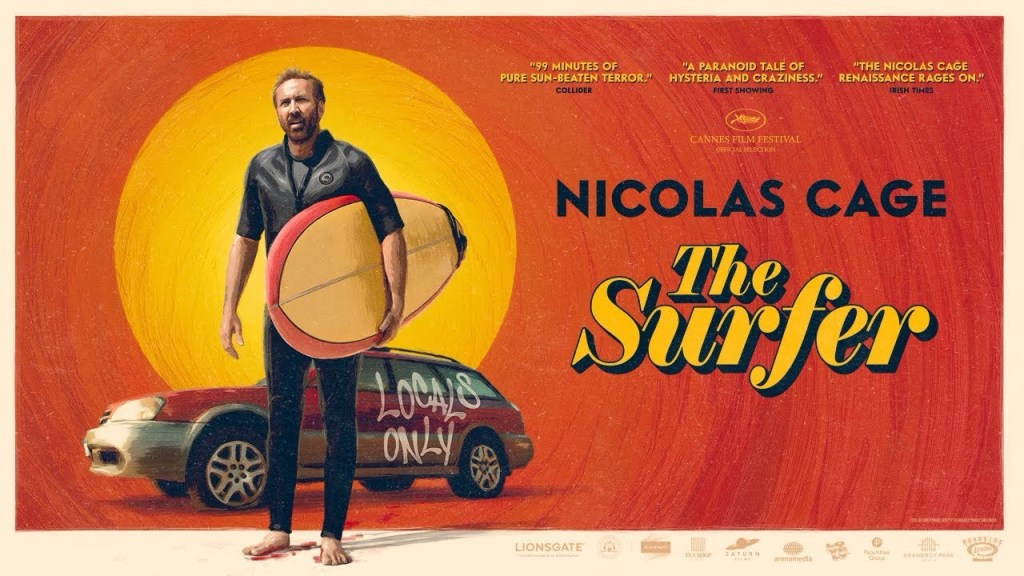
“Before you can surf, you must suffer.” Director Lorcan Finnegan ensures the audience does just that alongside Nicolas Cage’s titular character in “The Surfer,” a punishing but darkly funny surrealist thriller.
The Surfer (a character left gloriously unnamed), simply craves a surf with his teenage son on an idyllic beach. He is immediately thwarted by the locals, who have formed a territorial cult of hypermasculine, wealthy beach bros. Struggling to eat and drink in the sweltering heat, The Surfer is tormented into near madness as he tries to free his path to the waves, and salvage something lost in his life that’s bigger than his board.
Finnegan’s allegorical tale (penned by Thomas Martin) is well-suited to Cage. His carnal and feverish performance is perfectly matched with a story about the torture of being cast out of what once came freely: an ocean, a home, a place, a life.
Recent films like “Mandy,” “Dream Scenario,” “Longlegs” and now “The Surfer” have tapped into some of Cage’s zany, explosive onscreen abilities in new ways. He has mentioned in recent interviews that he is frequently and intentionally working with younger filmmakers who watched his work growing up. The result is a highly intentional deployment of his abilities that — in this instance — add gasoline to already blazing fire.
Those looking for Cage meme moments will not be disappointed. The words “eat the rat” are uttered. Freakouts and meltdowns occur in perpetuity. A powerful cocktail of rich, surrealist cinema and balls-to-the-wall Cage is mixed and served.
Finnegan uses his lead as an instrument, poking at toxic masculinity and the weird cults one has to subscribe to in order to simply exist in this world. “Don’t live here, don’t surf here” is a mantra of the exclusive bunch. Only those with affluence and the correct type of manly aura — as determined by their leader Scally — is permitted to join the group. They surf by day and party by night (and probably fit in a few Joe Rogan podcasts here and there).
The Surfer’s hazy journey is jarring and viscerally upsetting for much of its runtime. From the opening credits, hostility reigns and confusion swells — the audience is out in the heat and the filth with its hero. As he gets further disoriented, so do we, to the point where reality itself becomes an uncertainty.
Both a parable and an intense, at times psychedelic experience, “The Surfer” melts with influences such as Peter Weir’s “Picnic at Hanging Rock” (1965) and Frank Perry’s “The Swimmer” (1968). There is something quite contemporary too in its social observations. The rich, jacked beach bros make the rules, no matter how insufferable or unjust they might be, and the institutions gladly allow for it. But their actions have unforeseen consequences, which come to a head in a startlingly impactful conclusion.
For Cage enthusiasts, “The Surfer” will likely be a winner. For everyone else, the beach is open and the tide is high. Feel free to ride the wave (but maybe don’t eat the rat).
 Watching the Credits